William Edward “Bill” Nicholson
Bill was born in Scarborough on January 26, 1919. He moved from Yorkshire at just 17 years of age and so started his association with the club for the rest of his life.
Bill was Spurs through and through. He led the club to a level of success never previously seen at White Hart Lane, nor since. He built three successful sides in his sixteen years in charge at WHL, ensuring his teams always played in the Spurs tradition of entertaining and attacking football.
Bill wasn’t just the club manager, he had worked in a variety of roles before his finest appointment, his first job at the club was working with the ground-staff in 1936 before signing on as a professional player at White Hart Lane and establishing himself as a centre-back. In 1955 he was appointed coach under Jimmy Anderson, before replacing him in 1958 to begin his revolution. He won his first game in charge 10-4, as his Spurs beat Everton!
The Tottenham Weekly Herald dated Friday, March 13 announced: “On Trial. Spurs are giving a month trial to an amateur, Wm. E. Nicholson, an inside right of Scarborough Working Men’s Club. He recently celebrated his 17th birthday. His height is 5ft 8ins and weight 10st 12 lbs.”
After a month’s trial, he was taken on as a ground-staff boy earning £2 a week.
As a Spurs player, he made 341 appearances for the club, scoring 6 goals. Would have been so many more, but for the 6 years lost due to the Second World War when he probably would have been at his prime as a player. Despite losing around half his playing career as a result, he would later say he did not regret this as his experiences taught him the man-management skills which were to have such a great effect later in his career

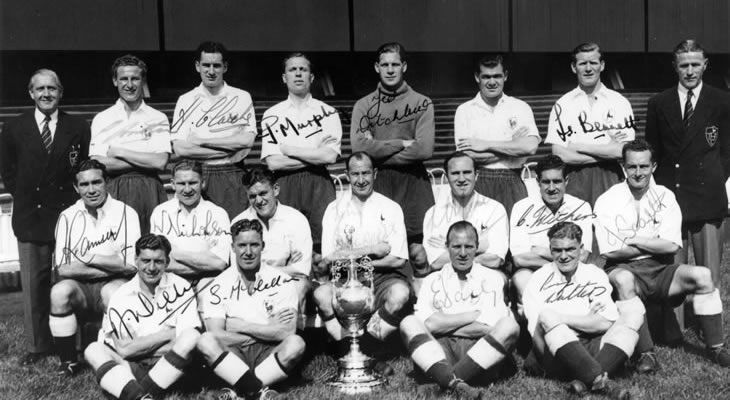
Bill returned to the club in 1946 after the war. He would play at centre half for two seasons, then moving to right half for a further six years. He was a vital part of the legendary “push and run” Tottenham team which won the league championship in the 1950–51 season.
As a player for Spurs, he won :
Division 2 title in 1949/50, Division 1 League title 1950/51 and FA Charity Shield 1951
England Cap
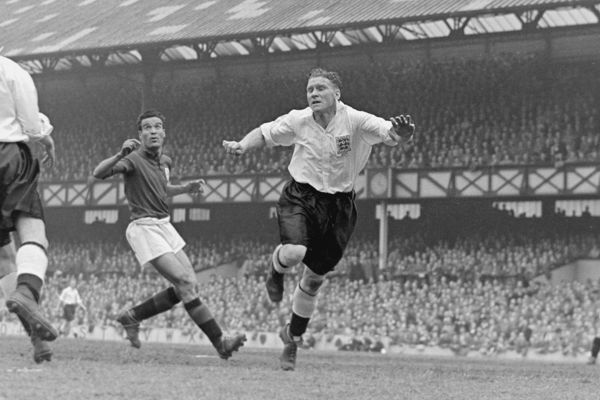
This was reflected in his call up to the England team – although he has long been a reserve for the England team, travelling to the 1950 World Cup as part of the squad. He made his full international debut for England on 19 May 1951 against Portugal at Goodison Park and made an immediate impression by scoring with his first touch of the ball after only 19 seconds! This proved to be his only international appearance due to injuries, the dominance of Billy Wright, and his habit of putting Spurs before his country. Nicholson is quoted as saying
“My duty is to get fit for Tottenham. Well, they pay my wages, don’t they?”
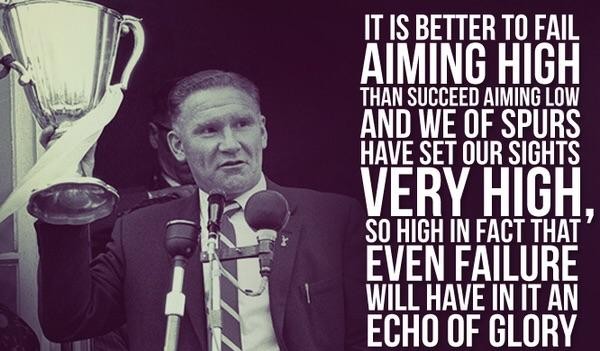
The Manager
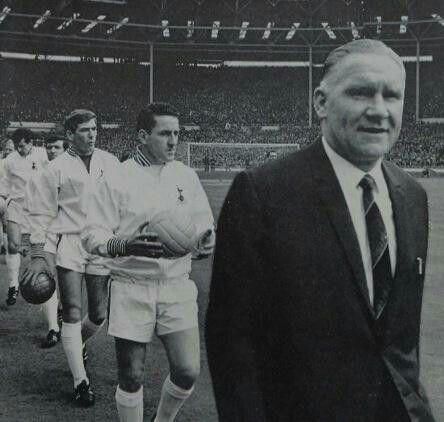
Bill took over as Tottenham manager in October 1958, having been on the coaching staff since 1955. At the time, the club was sixth from the bottom of the First Division and there was little indication that the greatest period in the history of the club was about to begin. That afternoon, in the club’s first game under Nicholson’s management, Spurs beat Everton 10-4 at White Hart Lane.
The Double
The Double of 1961 saw him join the shortlist of men to have won the championship both as player and manager. Spurs dominated the opposition that year, winning their first eleven games and scoring 115 goals in 42 games.
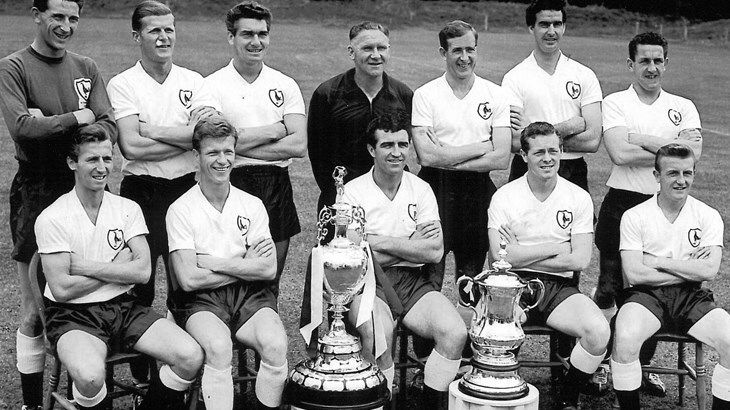
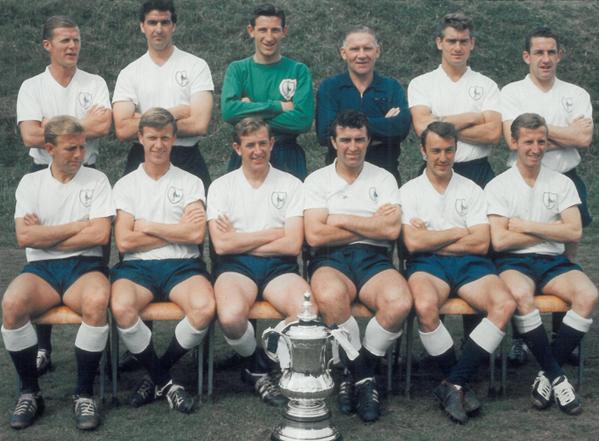
The FA Cup was retained in 1962, and Spurs narrowly missed a place in the European Cup final, losing to Eusebio’s Benfica in the semi final of the competition.
European Success
The 1962-1963 season will always be remembered by Spurs’ fans as their team became the first British club to win a major European trophy. In Rotterdam on 15 May, 1963, Spurs defeated favourites Atletico Madrid 5-1 to win the European Cup Winners Cup.
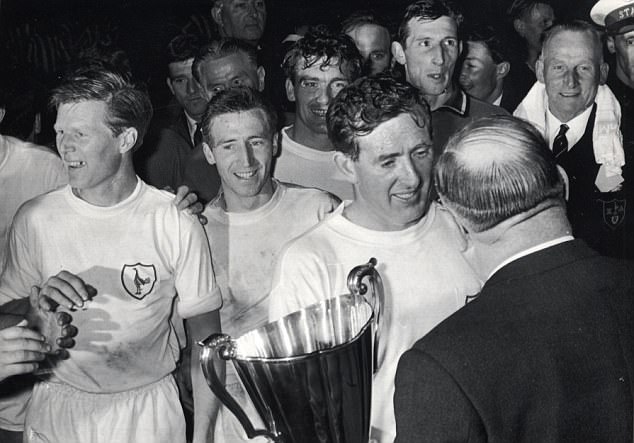
Further Cup Success
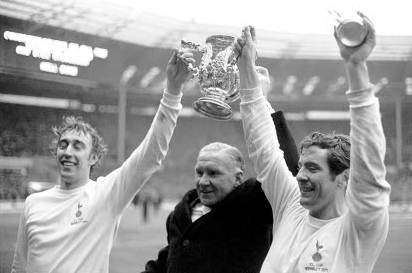
In 1967 Nicholson’s Spurs won their third FA Cup in seven years by beating Chelsea in the first-ever all-London final. This was followed by a string of trophies in the early 1970s – the League Cup was won in 1971 and 1973, and the UEFA Cup in 1972.
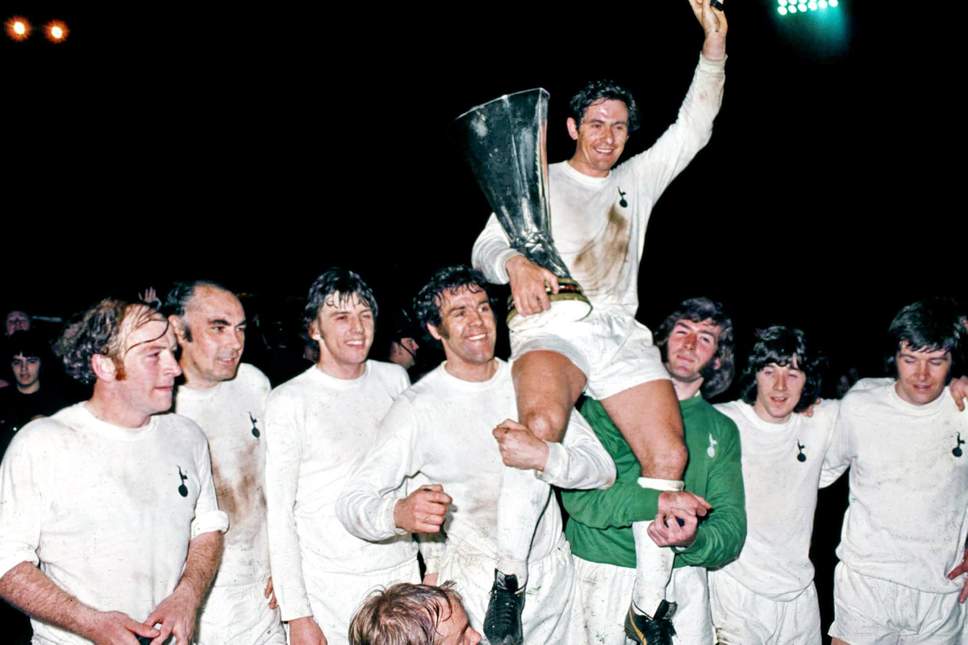
The 1972 UEFA Cup Final was the final of the first ever UEFA Cup football tournament. It was a two-legged contest played on 3 May and 17 May 1972 between two English clubs, Wolverhampton Wanderers and Tottenham Hotspur.
Spurs won the tie 3–2 on aggregate. A 2–1 victory away from home in the first leg proved decisive for them, with Martin Chivers scoring a remarkable late winner, firing in an unstoppable shot from 25 yards. They then held Wolves to a 1–1 draw in the second leg to win the competition.
Honours and Feats
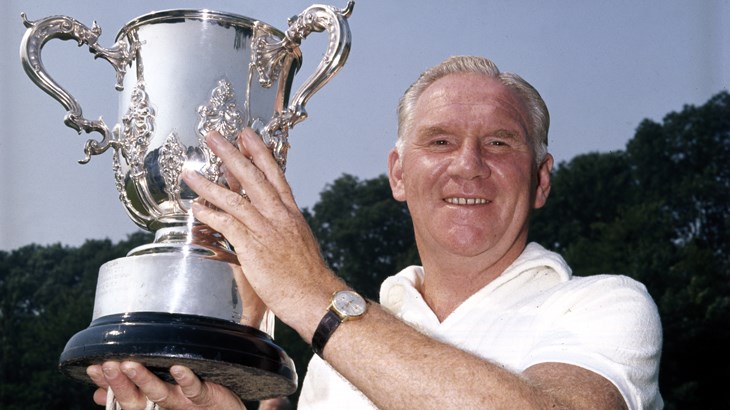
Honours as Tottenham Hotspur Manager
- Football League Champions: 1960–61
- FA Cup: 1961, 1962, 1967
- League Cup: 1971, 1973
- FA Charity Shield: 1961, 1962, 1967 (shared)
- UEFA Cup: 1972
- European Cup Winners’ Cup: 1963
His feats as club manager brought many firsts:
- the first Double of the 20th century
- the first European trophy win by a British club
- the first British team to win two different European competitions
- the first to win the League Cup twice.
He was manager for 16 years and took charge of 832 matches,
winning 408, drawing 196 scoring 1596 goals. Winning 11 trophies.
With a general change in attitudes in British football in the early 1970s, in particular negative tactics and player power, Bill resigned as manager of Spurs at the end of August 1974 (agreed to stay on until club found a replacement, so last match in charge was 11th Sept 1974), a few months after Spurs had lost the 1974 UEFA Cup final to Feyenoord. Bill was reacting to what he considered were disturbing trends in football. He despised the onset of functional modern modes of play, was out of tune with the new, precocious breed of player, was sickened by widespread hooliganism.
Bill recommended Danny Blanchflower as his successor, but the board did not listen and instead made the terrible choice of Terry Neill.
Following a spell on the scouting staff at West Ham United he returned to serve Spurs as a consultant and chief scout in July, 1976. His connection with Spurs scouting department continued until his retirement in July, 1997. In July, 1991 he was appointed Club President.
Amongst his personal honours, Bill received an O.B.E. in 1975, the PFA merit award in 1984 and in September, 1970 and other several awards. Macmillan published his autobiography “Glory, Glory, My Life With Spurs” in 1984. In December, 1998 he received the Freedom of the Borough from Haringey Council and the road leading to the Club from Tottenham High Road was renamed Bill Nicholson Way. The official unveiling of the newly named road took place in April, 1999 and is now incorporated into the club address.
A near sell out crowd numbering 35,877 delayed the kick-off for 10 minutes when Spurs organised a testimonial for Bill against AC Fiorentina on Wednesday, August 8, 2001. An emotion-charged evening saw Les Ferdinand, Gustavo Poyet and Steffen Iversen score Spurs goals in a 3-0 victory.
Bill became the first inductee into the Tottenham Hotspur Hall of Fame at a dinner held on March 11, 2004. The event was attended by 10 members of Spurs’ Double winning squad. He was similarly honoured a couple of months later by The National Football Museum based at Preston.
Summing up his philosophy, Nicholson said:
‘It is better to fail aiming high than to succeed aiming low. If you don’t have to drag yourself off the field exhausted after 90 minutes, you can’t claim to have done your best. The public can’t be kidded. They know what they want to see, what is good and what is bad and what is just average. At least I believe they do.”
An impeccable judge of character and ability, he bought brilliantly, got the best out of players already at his disposal and will always be remembered as one of the greatest manager in the game.
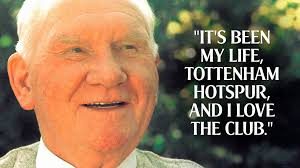
Naturally I’m a Tottenham man. So far as football is concerned, it means almost everything, doesn’t it really? Because I can reflect back to being a player with, and manager of some of the finest players that have ever been in the game. It’s been my life, Tottenham Hotspur, and I love the club.