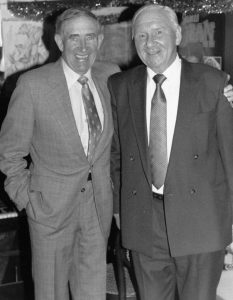
One of the greatest players and captains in our club’s history, Robert Dennis “Danny” Blanchflower, was born on this day in 1926
“The great fallacy is that the game is first and last about winning. It’s nothing of the kind. The game is about glory. It’s about doing things in style, with a flourish. About going out and beating the other lot, not waiting for them to die of boredom!”
Danny Blanchflower left an indelible mark on the history of our great club with his often innovative captaincy.
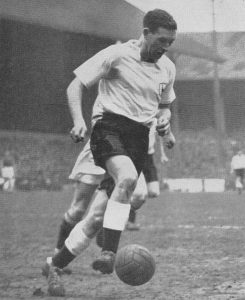
For all his excellence, he was not a spectacular footballer, more a subtle, creative and influence from his position of right-half (midfielder for younger readers!). In his prime, he was one of the most creative players in the game, capable of dictating the tempo of a match like few others.
Neither quick nor muscular, though endowed with a strength, Danny had an instinct for slipping into space at crucial moments. He would also impose his presence with his remarkable passing skills. One moment he’d be shackled, the next free and bellowing for possession; then, an instant later, the ball was nestling in the opponents’ net, deposited there by Jimmy Greaves, Bobby Smith or Cliff Jones, but all courtesy of their skipper’s exquisite vision.
But let’s go back to the beginning……
Danny started his career with Glentoran, before crossing the Irish Sea to sign for Barnsley in 1949. In 1951 he transferred to Aston Villa for a fee of £15,000 and spent 3 years with the Midlands club, making 155 appearances. His keen eye for the style in which the game should be played meant he became disillusioned with life at Villa and had disagreements with management (something that had also occurred at Barnsley, for similar reasons). He disliked was the fact the players were never allowed to practice with the ball during training but largely spent their time lapping the pitch and without a ball to practice with. He tired of the inability of Aston Villa to escape from the memories of the past and an inability to look at the change in tactics required to advance the club.
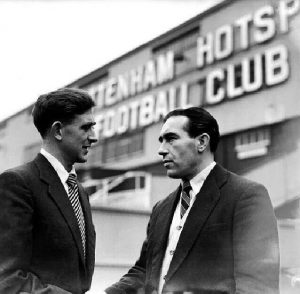
He signed for Spurs in 1954 for £30,000 – a huge fee for a 28 year old. However, the moment he became available, both Tottenham and the bitter rivals Arsenal submitted formal bids for him. An auction ensued and when Arsenal refused to go over £28,500, Spurs bid £30,000 and secured his services.
Danny would have a successful time with the club, making 387 appearances and scoring 21 goals, winning:
1 x League Championship – 1960/61
2 x FA Cups – 1961, 1962
1 x European Cup Winners Cup – 1963
2 x FA Charity Shields – 1961, 1962
2 x Football of the Year Awards – 1958, 1961
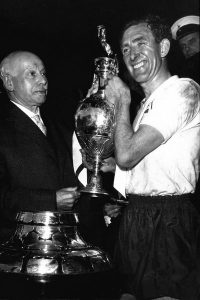
However, the first few years at The Lane didn’t go smoothly either, with more disagreements with management. Not long after Danny signed, the manager, Arthur Rowe, left the club on health grounds and Jimmy Anderson took over – this came as a surprise to many, but it’s believed the club considered Bill Nicholson not to be ready just yet to take over (despite him being one of the club’s coaches and already making many decisions) and saw Jimmy as a stop-gap. However, despite Bill Nick’s input and decision making, it was Anderson who picked the team. He soon fell out with Danny who wanted the authority on the field to change the team about if the situation dictated it. The row came to a head when Spurs lost the 1956 FA Cup Semi-Final to Manchester City. Losing 1-0, Danny sent Maurice Norman up to help the attack but the equaliser refused to come. In the dressing room afterwards, manager and captain argued about the decision. Anderson sacked Danny as captain and dropped him for a vital relegation match at Cardiff. Danny refused to play with the official line that he was injured and made it clear he had been dropped.
“Our tactics have always been to equalise before the other team score. Now I think they scored first and then we equalised, but we equalised the second time before they scored!”
Spurs then had two good seasons under Anderson without ever looking likely to win the League. Despite being deprived of the captaincy, Danny grew ever more influential and in 1957-58 completed what was arguably his most brilliant individual campaign, which he climaxed by leading Northern Ireland to the last eight of the World Cup. Deservedly, he was named Footballer of the Year (an accolade repeated in 1961). But at the start of 1958-59, Spurs made an awful start to the season and Anderson took ill with the worry of it all. On October 11th 1958, Anderson resigned as manager and Bill Nicholson took over.
An early decision that Bill made as manager was actually to drop Danny. He pointed to the fact that both Danny and Jim Iley liked to play an attacking role and that left great big chunks in defence for Norman to cover. Danny promptly asked for a transfer saying that he had no wish to play in the reserves at his age. By now Blanchflower was 33 and the end might have been imminent, however, the astute Nicholson had none of it. He turned down a transfer request and when the club continued to slide towards the bottom of the table, Bill Nick recalled Danny, albeit as a replacement for Tommy Harmer. This was a major change and Danny began to pull the strings and breathed confidence into Tottenham’s team. Bill Nick restored Blanchflower to his proper position and re-instated him as captain of the team. That decision plus the arrival of David Mackay & John White eventually saw Tottenham climb above the hurly burly of the relegation battle, then in the next season (1959/60 the prelude to the double season) the team really started to gel and the rest, as they say, is history!
“Hoddle a luxury? It’s the bad players who are a luxury.”
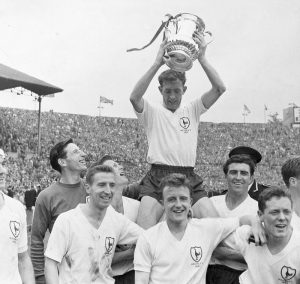
Danny captained the club during the glorious period of the early 1960’s. Little need reminding of the 1960-61 season. Spurs won the first eleven games of the season, drew the twelfth, won the next four and did not suffer their first defeat until the seventeenth match of the season at Hillsborough. By the turn of the year, they were 11 points out in front and free to concentrate on the FA Cup. Eventually, they won the title by 8 points and beat Leicester City in the FA Cup Final. Danny was awarded the Football Writer’s Footballer of the Year in 1961 – and remains one of the few to have won this honour twice, having won it previously in 1958 (the year he also captained Northern Ireland to the World Cup Quarter Finals).
Danny almost captained the club to a second successive Double in 1961/62, in fact, had they won one of the two matches against Ipswich Town, they would have achieved it! They settled for the 1962 FA Cup win and unluckily lost in the European Cup Semi Final to eventual winners Benfica.
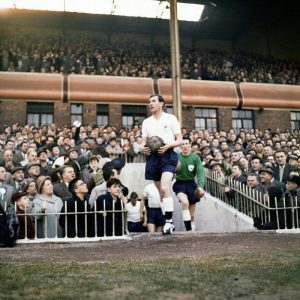
In 1962/63, the club became history makers again, becoming the first British club to win a European trophy with their 1963 ECWC victory. However, it was during this season that there were signs that Danny was approaching the end of his career. He missed a large chunk of the season due to injury, although returned in time to play a decisive role in the 5-1 European Cup-Winners’ Cup Final against Atletico Madrid.
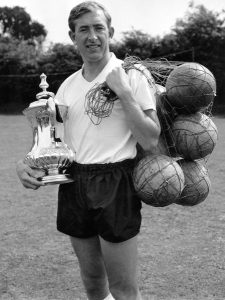
During the autumn of 1963, it was becoming clear that Danny’s playing days were numbered. He could not cope with the pressure of playing twice a week and when Phil Beal made his debut at Villa Park in the September, the writing was on the wall. Beal, although later filled Maurice Norman’s position, initially was seen as a direct replacement for Blanchflower. Danny’s final first team appearance was at Old Trafford in November 1963 when Manchester United thrashed Tottenham 4-1. Danny, outplayed in the match, who knew the game was up. He did not immediately announce his decision as, officially, he was injured but he knew the time had come to announce his retirement and did so in his newspaper column in April 1964.
“Ah well, ma’am. You see we all know each other” In response to Duchess of Kent at 1961 FA Cup Final asking why the Leicester players had names on the back of their tracksuits but the Spurs players didn’t

Following his retirement as a player, Danny coached at Spurs for a number of years, and double-winning manager Bill Nick intended for him to be his long-term successor. When Nicholson resigned from the club in 1974, he recommend Danny to the board for the position. However, the board ignored this and Danny found himself being passed over in favour of Terry Neill, and subsequently left the club himself.